Tokyo’s 25 Most Storied Hotels
A 1915 hotel inside a railway station, a 1928 banquet palace, capsule bunks behind bookshelves, and a Godzilla head over Kabukicho.
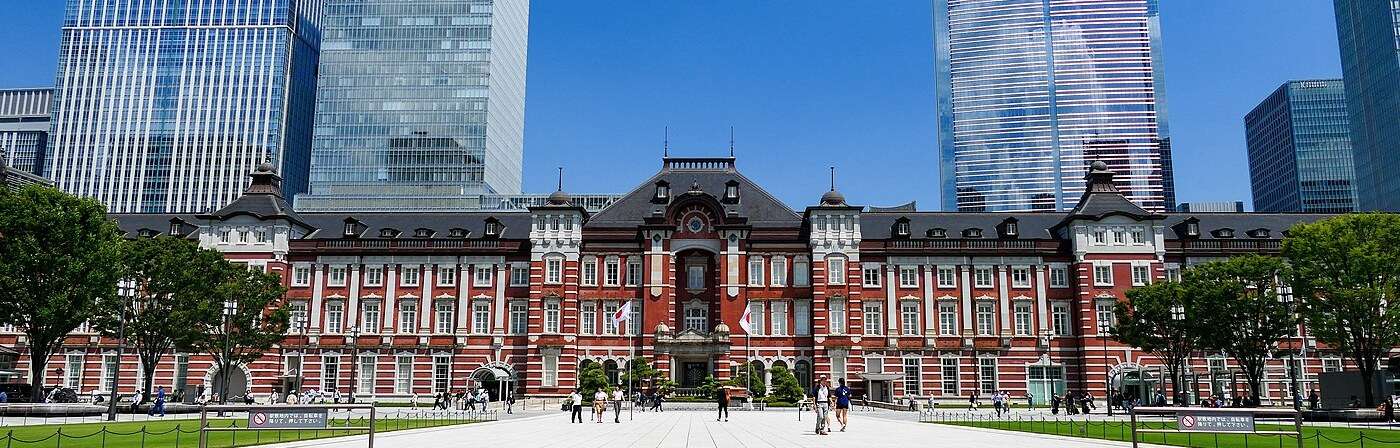
Tokyo rebuilds itself constantly, so a hotel that carries a real past is worth noting here. This list has a hotel inside a landmark railway station, a 1928 banquet palace once nicknamed the Dragon Palace, capsule bunks tucked into bookshelves, and a life-size Godzilla over a terrace in Kabukicho.
The list is grouped by character, not ranked, and runs from the grand survivors to the places that could only be Tokyo. Each hotel’s name links to its own site, where the rate is current and the booking is direct.
The grand old ones
Imperial Hotel Tokyo · Hibiya
The government pushed for a grand hotel to lodge foreign visitors, and the Imperial opened in 1890. Frank Lloyd Wright’s version of it opened on September 1, 1923, the morning the Great Kanto earthquake struck, and it rode out the quake; that building came down in 1968, and its carved entrance now stands at the Meiji-mura museum near Nagoya. The Old Imperial Bar keeps columns and lamps salvaged from the Wright lobby. A full rebuild by Atelier Tsuyoshi Tane is under way, and the hotel stays open through it.
The Okura Tokyo · Toranomon
The Okura opened in 1962 as a showcase of Japanese modernism, and its lobby — hexagonal lantern lights, chairs grouped like plum blossoms — became one of the most loved rooms in the country. The design world fought to keep it, but the 1962 building came down in 2015. It reopened in 2019 with the lobby rebuilt piece by piece by Yoshio Taniguchi, son of the man who designed the original.
Hotel New Otani Tokyo · Kioicho
The New Otani opened weeks before the 1964 Tokyo Olympics to take the rush of foreign visitors. Its ten-acre garden, with koi ponds and a red lacquer bridge, goes back some four hundred years to the daimyo estates that stood on the site. The 1967 Bond film You Only Live Twice used the hotel as Blofeld’s Osato Chemicals headquarters.
The Tokyo Station Hotel · Marunouchi
The hotel has been inside Tokyo Station’s red-brick Marunouchi building since 1915; the station itself, finished in 1914 to Kingo Tatsuno’s design, is an Important Cultural Property. A five-year restoration brought back the domes and the third floor the building lost in the war, and the hotel reopened in 2012. The mystery writer Seicho Matsumoto is said to have worked out the railway-timetable trick behind his 1958 novel Points and Lines from a room over the platforms.
Palace Hotel Tokyo · Marunouchi
The first Palace Hotel opened in 1961 on the site of the government-run Hotel Teito; the present building replaced it and opened in 2012. It sits right on the Imperial Palace moat, and some rooms have balconies over the water, which is rare this close to the center of Tokyo.
Keio Plaza Hotel · Nishi-Shinjuku
When it opened in 1971, the Keio Plaza was Japan’s first skyscraper hotel and the first tower in what is now the Nishi-Shinjuku high-rise district. At 47 floors it was briefly one of the tallest buildings in the country. It also runs officially licensed Hello Kitty rooms with Sanrio.
Hotel Chinzanso Tokyo · Sekiguchi
The statesman Aritomo Yamagata laid out this hillside garden from 1878, on a slope long known for its camellias — chinzan means camellia mountain. A three-storey pagoda in the garden was moved here from a temple in Hiroshima Prefecture in the 1920s. Several times a day the garden fills with an engineered sea of clouds, a low mist that rolls across the grounds.
Hotel Gajoen Tokyo · Meguro
Gajoen opened in 1928 as an extravagant banquet-and-wedding palace, so gilded it was nicknamed the Showa-era Dragon Palace. Its 1935 wing, the Hyakudan Kaidan, is seven painted banquet rooms strung along a 99-step wooden staircase, now a protected cultural property that holds regular art shows. Painted panels and carvings cover the building, and it is often named as an inspiration for the bathhouse in Spirited Away.
Ryokan, old and new
Hoshinoya Tokyo · Otemachi
Hoshinoya opened in 2016 as a tower ryokan in the middle of the Otemachi banking district: seventeen floors, shoes off at the door, tatami underfoot throughout. The open-air baths on the top floor draw real hot-spring water from about 1,500 metres below the office blocks.
Ryokan Sawanoya · Yanaka
The Sawa family has run this inn in Yanaka since 1949, in one of the few central neighborhoods whose old wooden streets came through the 1945 air raids. From the 1980s it became a base for foreign budget travelers, and the family helped set up the Japanese Inn Group that other small ryokan joined.
Sukeroku no Yado Sadachiyo · Asakusa
This Asakusa ryokan is done in Edo style, down to staff in kimono, and takes its name from Sukeroku, a hero of the kabuki stage. The rooms are all tatami, and there are two baths to soak in — one lined in hinoki cypress, one in black granite.
Homeikan · Hongo
Homeikan is a Meiji-era wooden ryokan near the University of Tokyo, and its main building is a registered cultural property. It has put up students, professors, and writers in the Hongo university quarter for generations.
Design statements, sky and street
Park Hyatt Tokyo · Nishi-Shinjuku
The Park Hyatt has held the top fourteen floors of Kenzo Tange’s Shinjuku Park Tower since 1994. Sofia Coppola shot much of Lost in Translation here in 2003, a lot of it up in the 52nd-floor New York Bar. It closed in May 2024 for its first full renovation and reopened in December 2025.
Aman Tokyo · Otemachi
Aman built its first-ever city hotel here, opening at the end of 2014 on the top six floors of the Otemachi Tower. Kerry Hill designed the lobby as a thirty-metre-high room wrapped in washi paper, meant to glow like a lantern over the city.
Mandarin Oriental, Tokyo · Nihonbashi
The hotel sits on the upper floors of the Nihonbashi Mitsui Tower, which went up beside the 1929 Mitsui Main Building — an Important Cultural Property and the old seat of the Mitsui combine. Cesar Pelli set his tower back from the street so the 1929 landmark still fronts it.
K5 · Kabutocho
K5 is a twenty-room hotel in a 1923 former bank, a block from the Tokyo Stock Exchange in Kabutocho. The Stockholm studio Claesson Koivisto Rune converted it in 2020, their first hotel in Japan, and left the bank’s old concrete frame on show.
Trunk(Hotel) Cat Street · Jingumae
Trunk opened in 2017 on Cat Street, between Shibuya and Harajuku, with fifteen rooms put together from local craft and recycled materials. Its lobby was built to work as a neighborhood hangout, and the idea carried into a second Trunk by Yoyogi Park in 2023, this one with a rooftop infinity pool facing the greenery.
ONE@Tokyo · Oshiage
Kengo Kuma designed this one in the shadow of Tokyo Skytree, with the latticed timber and plywood screens he is known for. It relaunched under Agora Hospitalities in late 2022.
Toggle Hotel Suidobashi · Suidobashi
Toggle opened in 2021 on a triangular sliver of land wedged between an expressway ramp and the Kanda River. Klein Dytham gave every floor its own two-color scheme, and the pairings run straight out onto the building’s striped facade.
Only in Tokyo
Hotel Gracery Shinjuku · Kabukicho
A life-size Godzilla head rears over the eighth-floor terrace, roaring and lighting up on a schedule, and it has been there since the hotel opened in 2015. The Gracery tops the Shinjuku Toho Building, which rose where the Shinjuku Koma Theater stood from 1956 to 2008. Some rooms look Godzilla in the eye.
Henn na Hotel Tokyo · Ginza and other branches
The Henn na brand started in 2015 at Huis Ten Bosch as the world’s first robot-staffed hotel, a Guinness record, and reached Tokyo from 2018 — some front desks are worked by humanoid robots, others by dinosaurs. The experiment had limits: in 2019 the chain pulled more than half its robots after they made more work for the human staff than they saved.
Nine Hours · Otemachi and other branches
The capsule chain Nine Hours began in Kyoto in 2009 on a simple formula — one hour to wash, seven to sleep, one to get ready. Some of its Tokyo locations will record your sleep and breathing overnight and hand you a report in the morning.
Book and Bed Tokyo Shinjuku · Kabukicho
Book and Bed calls itself an accommodation bookshop: the beds are tucked into the shelving, behind thousands of books you can read all night. The first one opened in Ikebukuro in 2015 and closed in 2021; the Shinjuku branch, looking down over Kabukicho, keeps going.
BnA_WALL · Nihonbashi
Every room is a work by a different Japanese artist, and the artist takes a share of the room’s nightly rate. The project grew from a two-room artist-run place in Koenji in 2016 into this Nihonbashi hotel in 2021, built around a huge indoor wall that invited artists keep repainting.
Nui. Hostel & Bar Lounge · Kuramae
Nui opened in 2012 in a former toy warehouse in Kuramae, the work of the Backpackers’ Japan collective. Its ground-floor bar helped turn the district’s craft workshops into the quarter people took to calling Tokyo’s Brooklyn.
Frequently Asked Questions
Are these hotels ranked?
No. The groups sort them by character, and the order within each group carries no meaning.
What made a hotel interesting enough for this list?
A story. Every entry was built as something else, survived something, or made its own history — a bank, a banquet palace, a station building, a robot experiment. Comfort alone did not qualify a hotel.
Why are there no prices?
Rates change daily and a priced list goes stale in a month. Every hotel name links to its own site, where the rate is current and you book direct.
Which hotel puts me closest to the day trips on this site?
Most day trips from Tokyo leave by train from the big terminals. The Tokyo Station Hotel is inside one; the Keio Plaza and the Park Hyatt stand by Shinjuku; Sadachiyo and Sawanoya put you near Asakusa and Ueno for the northern lines.
Do the small places book out faster than the towers?
Usually. The ryokan and the small oddities — Sawanoya, Sadachiyo, K5, Book and Bed — hold few rooms and fill first. Book those before the big houses.